


Scroll down for more detailed information!
If you want to hear about the product, click the "Listen" button"
DISCLAIMER / disclaimer
Dietary supplements are not medicines and are not intended to diagnose, treat, or prevent any disease. They cannot be considered a substitute for medical treatment or medications prescribed by a doctor.
All information presented here is for educational and informational purposes only. It does not constitute medical advice, a diagnosis, or an individual treatment recommendation.
Each person makes the decision to use dietary supplements at their own responsibility. Before starting supplementation, especially in the case of chronic illnesses, pregnancy, breastfeeding, or taking medications, consult a doctor. or another qualified healthcare professional.
For additional information regarding your own health condition, possible contraindications, drug interactions, and the proper use of supplements, consult your doctor.
Protein and peptide (proteolytic) enzymes
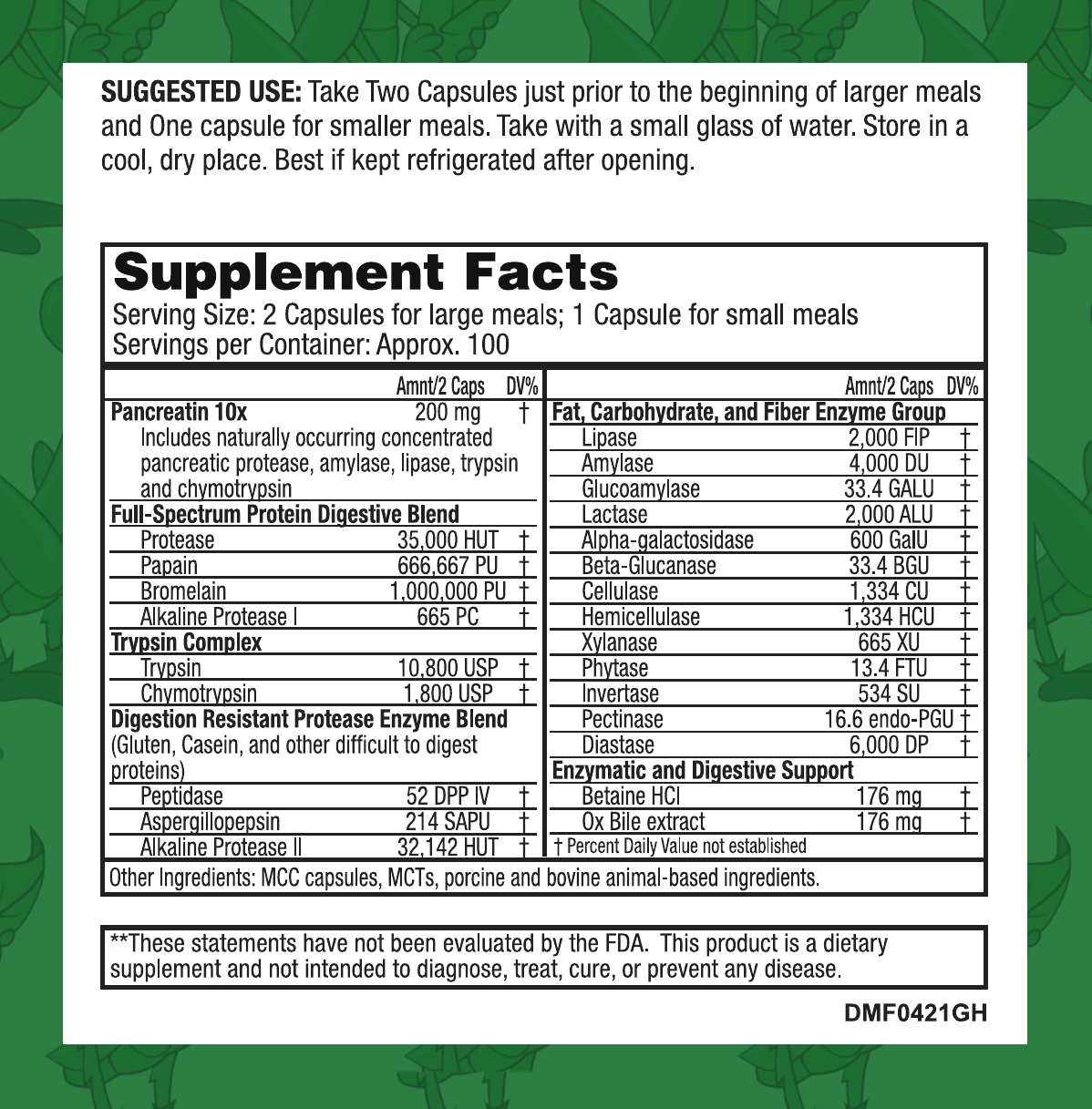
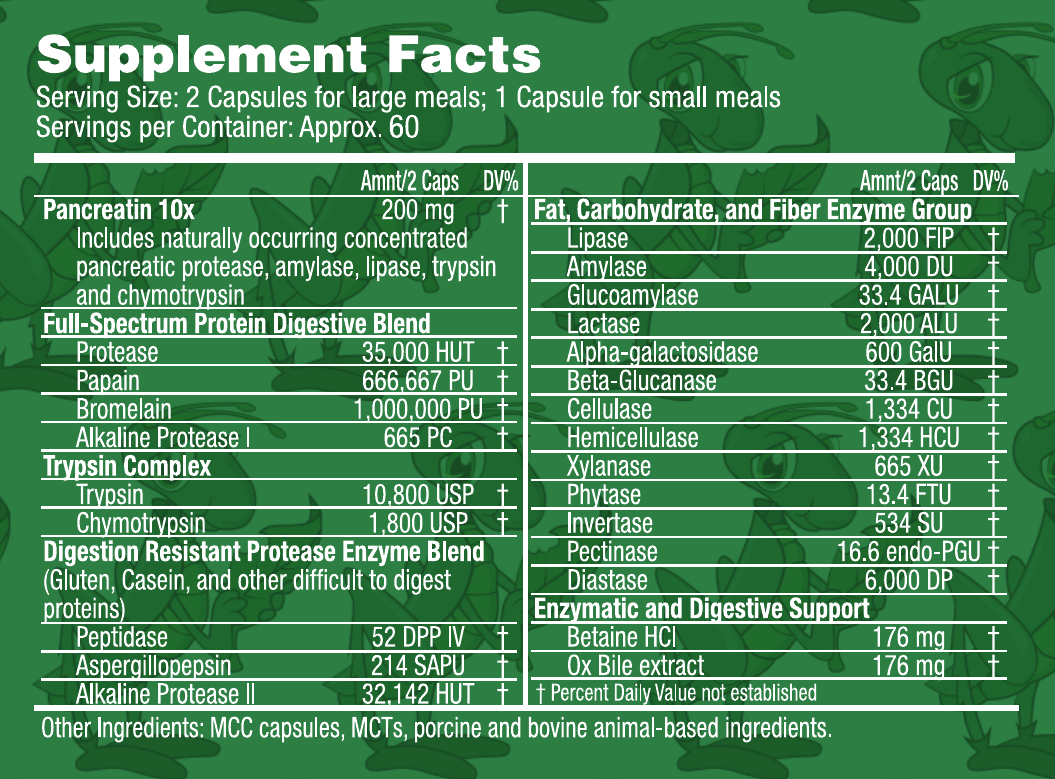
- Pancreatin 10X
A pancreatic enzyme complex with very high activity (ten times greater strength).
Use: Indigestion, pancreatic enzyme deficiencies, inflammation, support in cancer treatment (by breaking down the protein coating of cancer cells), overall regeneration. - Protease
An enzyme that breaks down proteins into peptides and amino acids.
Use: Protein digestion, support for healing, anti-inflammatory effects, alleviation of food allergy symptoms. - Papain
An enzyme from papaya that breaks down even proteins that are very difficult to digest.
Use: Improved digestion of meat, support in autoimmune diseases and inflammatory conditions. - Bromelain
Pineapple-derived enzyme with strong anti-inflammatory properties.
Use: Swelling, joint pain, relief of inflammation, immune system support, cancer prevention. - Alkaline Protease 1 and 2
Works best in an alkaline environment, supporting protein digestion in the small intestine.
Use: Protein digestion, elimination of undigested food residues. - Trypsin Complex (Trypsin and Chymotrypsin)
Key pancreatic enzymes for protein breakdown.
Use: Digestion, postoperative support (dissolving blood clots, reducing swelling), cancer prevention. - Protease Enzyme Blend Peptidase
A complex of various proteases and peptidases for complete protein breakdown.
Use: Deep cleansing of the body, support for the immune system. - Aspergillopepsin
Fungus-derived enzyme for breaking down proteins in acidic conditions (stomach).
Use: Aid in digesting food for people with low stomach acid production.


Enzymes that digest fats, carbohydrates, and fiber
- Lipase
Essential for digesting fats into fatty acids.
Use: Indigestion after fatty meals, support for the liver and pancreas. - Amylase, Glucoamylase
They break down starch, complex sugars, and glycogen.
Use: Bloating, a feeling of heaviness after carbohydrates. - Lactase
An enzyme that digests lactose (milk sugar).
Use: Lactose intolerance, bloating, and diarrhea after consuming dairy products. - Alpha-Galactosidase
Breaks down oligosaccharides (beans, peas, legumes).
Use: Bloating, gas after eating legumes. - Beta-Glucanase
Facilitates the breakdown of dietary fiber (beta-glucans).
Use: Improved nutrient absorption, microbiome support. - Cellulase, Hemicellulase, Xylanase, Pectinase
They break down cellulose, hemicelluloses, and other plant fibers.
Use: Better digestion of vegetables and fiber, prevention of constipation. - Invertase, Pectinase, Diastase
They facilitate the breakdown of complex sugars and pectins.
Use: Improved digestion of fruit, reduced fermentation in the intestines.
Support for digestion and absorption
- Betaine HCl (betaine hydrochloride)
An acid that supports stomach acidification and the activation of digestive enzymes.
Use: Low stomach acidity, indigestion, heartburn, support for protein and mineral absorption. - Ox Bile Extract (bovine bile extract)
Natural bile, supporting fat digestion and the absorption of vitamins A, D, E, and K.
Use: Problems with fat digestion after gallbladder removal.
Health applications of the enzyme blend
- Improved digestion all nutrients – proteins, fats, carbohydrates, fibre, lactose.
- Reduction of bloating, gas, constipation and indigestion.
- Support in inflammatory conditions – proteolytic enzymes reduce swelling and pain, and promote tissue regeneration.
- Cancer prevention – breakdown of the protein оболочкa of cancer cells (support for the immune system).
- Support for the treatment of allergies and food intolerances (lactase, proteases).
- Recovery after surgeries and injuries (bromelain, trypsin, chymotrypsin).
- Improved absorption of vitamins, minerals, and trace elements.
Who is this set for?
- People with digestive problems
- In cases of chronic fatigue and autoimmune diseases
- For cancer prevention and post-operative recovery
- People after gallbladder removal
- Anyone who wants to support their digestion and immunity naturally

Grasshopper Healthy Family Pharmacy – Digestive Enzymes that work!
Read more!
If you have bloating, reflux, a hiatal hernia, inflammation, need support with oncological issues—in short, if you struggle with problems resulting from a lack of enzymes, you will certainly be happy to hear about something that will solve this problem.
Because prevention is better than cure.
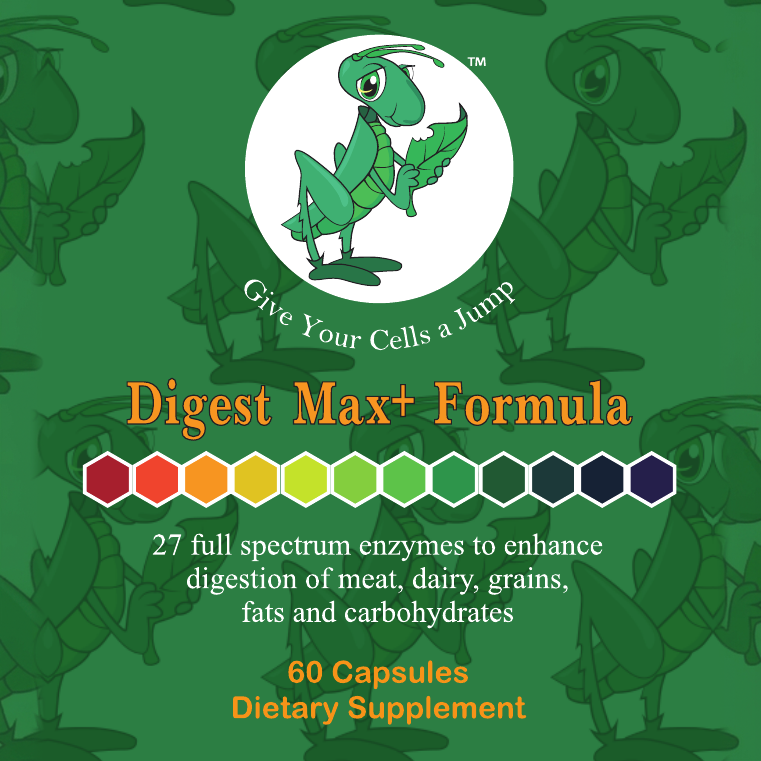
Digest Max + Grasshopper Formula is one product that will solve many of your problems.
Enzymes – the vital workforce.
In the twenty-eighth edition of Dorland’s Illustrated Medical Dictionary, an enzyme is defined as follows: „A protein, that is, a protein molecule, which accelerates the course of a chemical reaction occurring between substances, without being destroyed or transformed as a result of the reaction.” Although this may seem like a sufficient definition, it does not explain why an enzyme is capable of doing what it does, nor how a protein can become an active enzyme.
In other words, since an enzyme is merely a protein molecule, why not produce it synthetically? The problem is precisely that, to date, no one has succeeded in creating a synthetic enzyme. Enzymes can be obtained only from living organisms, from organic material. It is therefore obvious that an enzyme must contain something more than scientists attribute to it.
Enzymes have been classified into several groups. Hydrolytic enzymes are the most important in clinical nutrition and are divided into three basic groups: digestive enzymes, which are produced by the digestive organs to support the digestive process; food enzymes found in all raw, uncooked foods; and metabolic enzymes, produced by all cells to carry out their assigned tasks.
And although there are many classes and subclasses of digestive enzymes, there are four main, basic types: amylase digests starch—including grains and starchy vegetables; cellulase breaks down plant fibers; lipase breaks down fats and oils into fatty acids; and protease, which breaks down proteins, amino acids, and short-chain peptides.
All the enzymes listed, except for cellulase, are produced in the human body. Cellulase must come from plants, and for this very reason it is important to chew plant-based food thoroughly. Cellulase is trapped within the fiber itself, that is, in dietary fiber, and must be released through thorough chewing. Otherwise, one experiences bloating and gas, especially in old age, when the ability to digest raw foods has already been lost. Fruits and vegetables with a high juice content also release cellulase from the fibers.
BUT WHAT EXACTLY ARE ENZYMES?
Enzymes are biologically active proteins that are necessary—indeed indispensable—for life. Although we mainly associate enzymes with digestion, they perform many more functions than we think. In fact, they are the workforce of living organisms. They are substances capable of and intended for doing work, so that the body digests properly, regenerates, and maintains immunity. They are constantly busy joining and separating. They initiate, accelerate, slow down, and stop all biochemical processes in living organisms.
All raw, uncooked foods contain the types and amounts of enzymes necessary to break them down and digest them. The ripening of fruit is the result of enzymes that slowly break down the fruit’s mass. When this process progresses too far before we consume the fruit, we usually say that it has rotted. There are optimal periods for harvesting and consuming particular fruits.
However, due to the so-called „shelf life,” fruits are picked while still unripe and ripen only later in a warehouse or greengrocer’s shop. In such a case, the amount of vitamins, mineral salts, and enzymes is insufficient from a nutritional point of view. Hence the deficiencies currently present in our bodies.
Of all nutrients, enzymes are the most sensitive to temperature. Heating food to a temperature higher than forty-seven point eight degrees Celsius for more than fifteen minutes destroys all enzymes, regardless of whether the meal is boiled, baked in an oven or on a spit, canned, fried, pasteurized, or steamed. And worst of all, heated in a microwave oven.
Dr. Howell, an outstanding researcher of the action of enzymes in the human body, compared such a process of continuously cooking food to a bank account. If someone keeps withdrawing money from it, they will never be able to replenish it and at some point will become bankrupt. In the case of enzymes, instead of bankruptcy, degenerative diseases and a very rapid aging process occur.
Doctors often tell you: „Oh, your symptoms are the result of old age; you simply have to get used to it.” From a cultural perspective, this seems true, since we observe this process from our earliest years. We even expect health to deteriorate with age, or this is instilled in us from childhood.
Meanwhile, life expectancy is inversely proportional to the amount of enzymes we use for digestion. The point is that if we consume raw food, it carries with it all the necessary enzymes required to digest it. However, if we constantly eat food—or rather, food that is baked, fried, and cooked—then the enzymes that are meant to perform other functions in our bodies are called away from their tasks because they are needed to digest what has entered the stomach. Our immune system suffers the most as a result.
Although we do not directly control these processes, a vast number of enzymes must be active for the body to cope with cells, viruses, and bacteria that are dangerous to it.
In the 1980s, Dr. Roy Waldford of the University of California, Los Angeles, conducted numerous experiments on animals. He reduced the amount of food they were given, and it turned out that their lives were extended beyond the expected lifespan. As a result, he suggested that simply eating less is enough to ensure a longer and healthier life.
At the same time, Dr. Paul, in his research on enzymes, discovered that during fasting, as a result of a lack of food—especially cooked food—the amount of enzymes in the body increases. In the absence of food, the body gains an additional supply of enzymes to repair damage and heal.
There are approximately three different types of enzymes in the blood that serve to cleanse the body of waste products and prevent disease. When the body’s supply of these enzymes is depleted, there is a risk of being attacked by some illness.
How could a deficiency of these enzymes arise? Well, when we consume cooked food, enzymes must be available to digest it. It is then that metabolic enzymes are diverted from their normal tasks to digestion, leaving the body without a protective shield against a potential disease attack.
How can one recognize the typical symptoms of a deficiency of the most common enzymes?
First and foremost, when someone has difficulty digesting carbohydrates, they may expect allergies caused by airborne allergens, diarrhea, fibroma, or attention deficit syndrome.
If someone has difficulty digesting fats, they may expect constipation, gallbladder problems, heart disease, or hormonal imbalance.
If someone has difficulty digesting proteins, they may expect constipation, arthritis or other inflammatory conditions, anxiety or panic attacks, severe premenstrual syndrome, or serious immune system deficiencies.
Another symptom of enzyme deficiency, that is, incomplete digestion, is excessive appetite. What we crave is usually food that is not being digested well. The hypothalamus, a gland in the brain, tells us what we should consume based on blood analysis. Thus, if we eat something and then crave the same thing, it means that we are not digesting it well. We continue to consume it because it contains something we need, but we have not received it in sufficient quantity.
It is assumed that we crave the enzymes that were present in food before it was heated. The enzymes whose deficiency we chronically feel are contained in the foods we crave.
Why is it important to know this? Because in the field of medicine itself, both old and new, there is a wide range of all kinds of therapies—from acupuncture and herbal medicine to diet, homeopathy, and energy medicine. The most important thing, however, is to know that regardless of the method chosen, healing can occur only when the body has a sufficient amount of metabolic enzymes to carry out the necessary tasks.
These are enzymes at work. Work in this case means the ability to initiate, alter, accelerate or slow down biochemical processes. It means the ability to break apart or combine components synergistically, changing their structure and the way they function.
Food processed during digestion is broken down into smaller components, which are then used by the body to build tissues. Proteins are broken down into amino acids and smaller peptides, which can in turn be used as neurotransmitters enabling the proper functioning of the brain. Some amino acids are used as energy carriers for transporting mineral salts and repairing tissues.
The problem nowadays is that nutrition is treated similarly to taking pharmaceutical drugs, where every symptom means that something is lacking. So it is enough to administer either minerals or vitamins, and the problems will disappear. Meanwhile, yes, that is how it works, but only provided that the patient's digestive system functions properly.
Worse still, continued consumption of cooked, enzyme-deprived food not only leads to enzyme deficiency, but also causes each successive generation to become more susceptible to disease, with the course of these diseases becoming increasingly severe.
It is time to think about real food, healthy food, and consequently, maintaining good health. For food nowadays is not our ally, but rather a burden.
Listen carefully.
At the beginning of this century, transporting food around the globe posed a serious problem. How could a food trading company send raw, unprocessed food while avoiding spoilage? A method of preparing it had to be found in order to prevent rotting.
At the beginning of the twentieth century, salicylic acid, or aspirin, was used because it deactivated enzymes such as diastase, or alpha-amylase. This shows that even then it was known that salicylic acid, or aspirin, was a clear antagonist to most enzymes.
Thus, as early as nineteen hundred and three, aspirin's effect on enzymes was known, and because of this property it was used to preserve food. With the invention of new preservatives, aspirin was abandoned.
Is it not strange, then, that many patients are advised to take aspirin as a means of preventing a heart attack, even though it destroys enzymes?
It is also known that salicylic acid has a destructive effect on blood cells. The thinning of the blood by aspirin consists in its destroying red blood cells, thereby reducing the density of the blood.
Therefore, if you desire your own health, be aware that only you yourself can save yourself and your loved one.
We strongly encourage you to take the time to learn about the basic functions of the human body, enzymes, beneficial bacteria, and above all, to return to food that is as pure and natural as possible.
And one more thing!!!
The body always knows what it needs and often gives us signs of deficiencies in certain nutrients. It is worth learning how to interpret them.
Each of us knows the feeling when we suddenly start craving a particular type of food. Sometimes there is an irresistible urge to eat something sweet; at other times, we feel like having something sour, spicy, or salty. Such signals very often indicate deficiencies of certain substances or mineral compounds that the body is demanding at that moment.
But as stated at the outset, eating even the best food will be of no use if it does not contain enzymes, and one of the best formulas of this kind is Digest Max + Formula from Grasshopper.
We encourage you to visit Grasshopper and take advantage of our offer of natural products, nutritional advice, and support in the process of returning to health. We believe that everyone has a chance to enjoy full health, energy, and a long, happy life.
And when it comes to enzymes, it would certainly be difficult to find a better set than Digest Max + Formula from Grasshopper.
Welcome to Grasshopper, where illness disappears.

Reviews
There are no reviews yet.